

Payroll math
How to Make Payslips Easier for Employees to Understand
Jun 25, 2026 · 4 min read
A payslip should answer questions, not create new ones.
For many small businesses, payroll questions repeat every cutoff:
- "Bakit ganito net pay ko?"
- "Magkano SSS ko?"
- "Nasama ba overtime ko?"
- "Bakit may bawas?"
- "May balance pa ba loan ko?"
These are not bad questions. They usually mean the employee cannot see the breakdown clearly enough.
Here is how to make payslips easier to understand.
Start with the pay period
Every payslip should clearly show the payroll period it covers. Without the period, the employee cannot tell which attendance records, leave days, or overtime hours were included.
This is especially important for semi-monthly payroll. An employee may remember working overtime on the 30th, but if the payslip covers only the 1st cutoff, that overtime may belong to the next run.
In Timekeep, each payslip belongs to a specific payroll run and cutoff period, so employees can review the right dates.
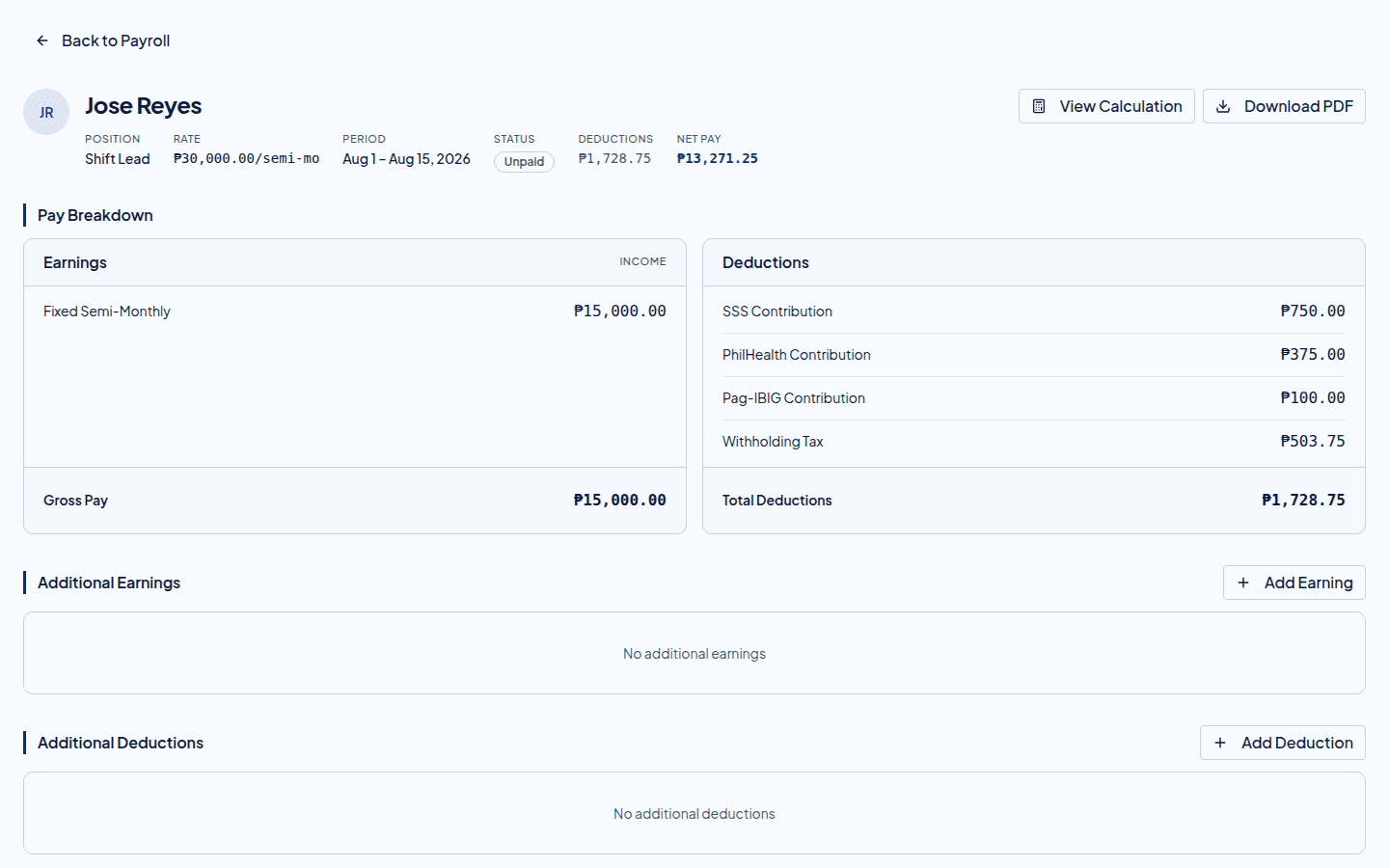
Separate earnings from deductions
The easiest way to make a payslip confusing is to mix everything into one list.
Keep earnings and deductions separate.
Earnings may include:
- Basic pay
- Holiday pay
- Overtime pay
- Night differential
- Paid leave
- Allowances
Deductions may include:
- SSS employee share
- PhilHealth employee share
- Pag-IBIG employee share
- Withholding tax
- Late and undertime deductions
- Overbreak deductions
- Loan deductions
- Recurring deductions
When employees can see the two sides separately, net pay becomes easier to follow.
Explain government contributions
SSS, PhilHealth, Pag-IBIG, and withholding tax are common sources of confusion because the amounts can change.
An employee may ask why SSS changed after a salary increase, or why withholding tax appears in one cutoff but not another. The answer may be correct, but the payslip should still make the deduction visible.
Timekeep computes government deductions automatically and shows them as separate lines on the payslip. That keeps the employee share visible and avoids burying contributions inside a generic "deductions" total.
Show attendance-based pay clearly
Attendance affects payroll in several ways:
- Late minutes can reduce pay.
- Undertime can reduce pay.
- Overtime can increase pay.
- Night differential can increase pay.
- Holiday work can increase pay.
- Approved leave can add paid days.
If those items only show as a final number, employees will ask follow-up questions. Itemized payslips reduce the back-and-forth because the reason is visible.
For example, "overtime pay" should not be hidden inside basic pay. "Late deduction" should not be hidden inside a miscellaneous deduction.
Make loan deductions traceable
Employee loans and cash advances can cause tension when the deduction is not clear.
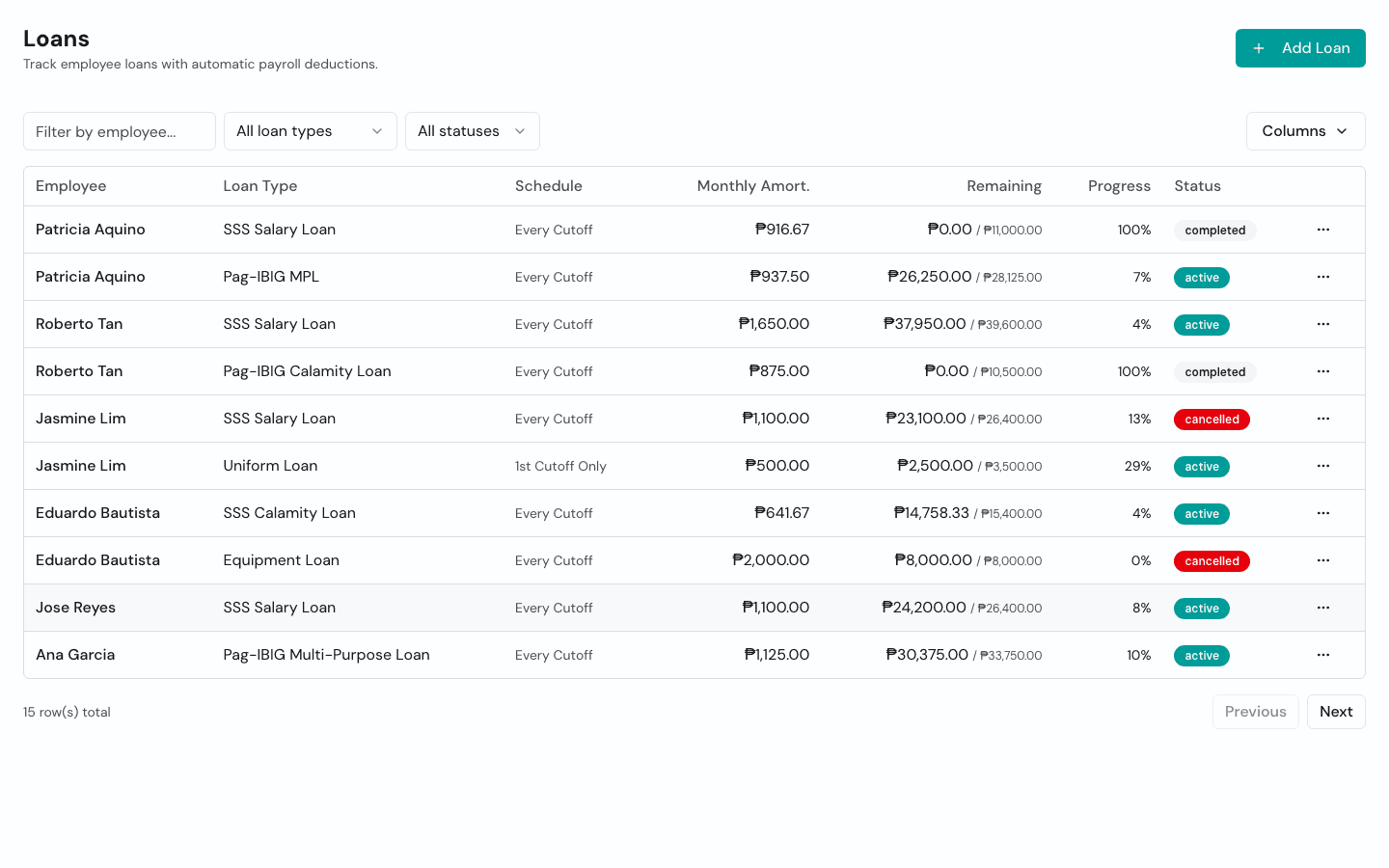
If an employee borrowed ₱5,000 and pays ₱500 per cutoff, they should be able to see the deduction on the payslip. The business should also be able to track the remaining balance, whether the loan is active, paused, completed, or cancelled.
In Timekeep, loan deductions can be applied through payroll and tracked against the employee's loan record. That gives both sides a cleaner history than a notebook or spreadsheet.
Give employees self-service access
Even a clear payslip creates extra admin work if employees have to ask for it every cutoff.
The better workflow is simple: once payroll is finalized, employees open the portal and view their own payslip. They can check the latest payslip, review older ones, and download a PDF when needed.
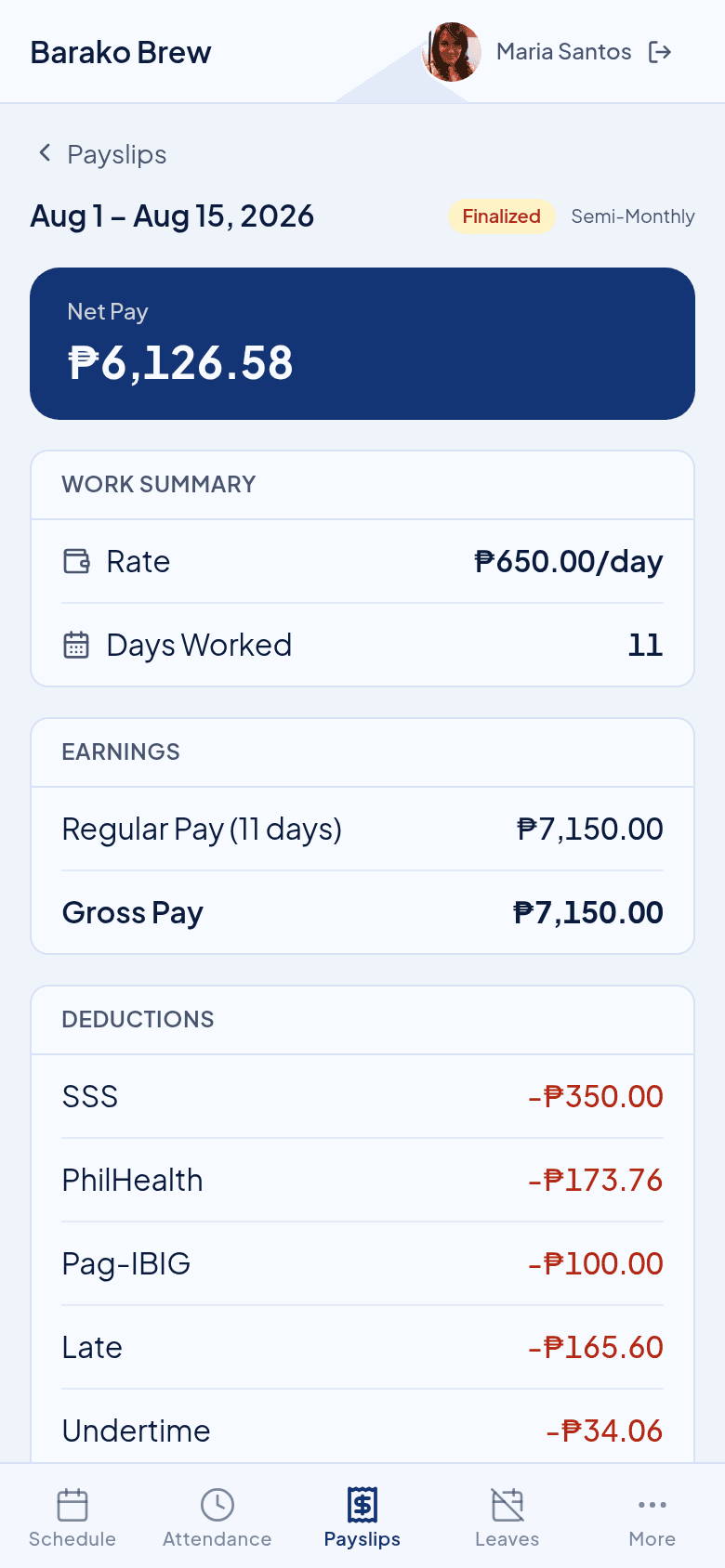
This reduces repeat messages and gives employees access to their own records without waiting for the owner, HR lead, or bookkeeper.
Keep draft payroll private
Employees should not see draft payslips while payroll is still being reviewed.
Draft payroll is where the business catches missing attendance, unapproved overtime, leave corrections, loan balances, and final checks. Showing a draft too early can create confusion because the numbers may still change.
In Timekeep, payslips become visible to employees after payroll is finalized. That gives admins time to review before publishing the final version.
Use plain names for pay items
Payslip labels should be understandable to the people reading them.
Use "Late deduction" instead of an internal code. Use "Pag-IBIG contribution" instead of "HDMF EE." Use "Loan deduction" with enough context to know which loan it belongs to.
Accountants may understand shorthand, but employees should not need payroll training to read their own pay.
The best payslip is explainable
A good payslip does not just show net pay. It shows how net pay happened.
For Philippine small businesses, that means clear earnings, visible deductions, separate government contributions, traceable loans, and employee self-service access.
When employees understand their payslips, payroll becomes calmer. The owner spends less time answering the same questions. The bookkeeper gets cleaner records. The team has more confidence that the numbers were computed properly.
Try Timekeep free for 30 days at timekeep.ph.
Quick answers
Frequently asked questions
What should employees be able to see on a payslip?
At minimum, employees should be able to understand their earnings, deductions, government contributions, loan deductions, net pay, and the payroll period covered.
Why do employees ask so many payroll questions?
Most questions come from unclear breakdowns. If overtime, late deductions, undertime, contributions, loans, and net pay are mixed together, employees cannot see how the final amount was reached.
Can employees view payslips in Timekeep?
Yes. Finalized payslips are available in the employee portal, where employees can view and download their own payslip without asking HR or the owner.
Should payslips show loan deductions?
Yes. Loan deductions should be visible so employees can understand why net pay changed and how the deduction relates to their remaining balance.