

Payroll math
13th Month Pay Computation Philippines: Rules and Examples
Aug 7, 2026 · 7 min read
It is December. Your team asks when the 13th month pay lands. You hired two people in March, one in August, and one person was absent for a week in September without pay. You know the rule is "one month's salary," so you plan to hand everyone a full month. Then your accountant tells you that three of those numbers are wrong.
The formula is short. The mistakes come from what you put into it.
The rule
Presidential Decree 851 requires every employer to pay 13th month pay to rank-and-file employees. Anyone who worked at least one month during the calendar year earns it. You must release it on or before December 24.
This is not a bonus. A bonus is discretionary. 13th month pay is a legal obligation, and DOLE monitors it every December.
The formula
13th month pay = total basic salary earned in the calendar year / 12
Note the two words that carry all the weight: basic and earned.
Always divide by 12. Do not divide by the number of months the person worked. The division by 12 is what creates the prorated amount for a mid-year hire.
What counts as basic salary
This is where most owners get it wrong. Only basic salary goes into the total. Leave these out:
- Overtime pay
- Holiday premium pay
- Night shift differential
- Rest day premium pay
- Allowances, such as meal, transport, and rice
- Cost of living allowance (COLA)
- Cash conversion of unused service incentive leave
- Profit sharing and discretionary bonuses
A team member who works heavy overtime does not get a larger 13th month pay. Their gross pay is higher, but their basic salary is the same. The same holds for night differential and overtime pay: both raise take-home pay, and neither raises the 13th month.
Example 1: a full year
A team member earns ₱18,000 a month. They worked the whole year with no unpaid absence.
Total basic salary earned: ₱18,000 x 12 = ₱216,000 13th month pay: ₱216,000 / 12 = ₱18,000
A full year of work gives exactly one month of pay. That is where the plain-language name comes from.
Example 2: a mid-year hire
You hired a team member on August 1 at ₱18,000 a month. By December 31 they have five months of service.
Total basic salary earned: ₱18,000 x 5 = ₱90,000 13th month pay: ₱90,000 / 12 = ₱7,500
Divide by 12, not by 5. Dividing by 5 gives ₱18,000, which is a full month for less than half a year of work.
Example 3: unpaid absences
A team member earns ₱18,000 a month. They missed three days in September without pay.
For a monthly-paid team member, the daily rate uses the 313 factor:
Daily rate: (₱18,000 x 12) / 313 = ₱690.10 Pay lost: ₱690.10 x 3 = ₱2,070.30 Total basic salary earned: ₱216,000 - ₱2,070.30 = ₱213,929.70 13th month pay: ₱213,929.70 / 12 = ₱17,827.48
Paid leave is different. If the team member used approved leave with pay, they still earned basic salary that day. The 13th month pay does not drop.
Example 4: a daily-paid team member
Daily-paid staff need the same approach, but you cannot estimate. You must add the real basic pay from each cutoff.
A team member earns ₱610 a day. Across the year, their payslips show ₱142,000 in basic pay after absences.
13th month pay: ₱142,000 / 12 = ₱11,833.33
This is why your attendance records matter in December. Bad records give you a bad total.
Who is covered
PD 851 covers rank-and-file employees. Length of service does not matter, as long as it reaches one month. Employment status does not matter either. Probationary, casual, and part-time staff all qualify.
These groups are outside the law:
- Managerial employees. A manager can hire, fire, or effectively recommend such action.
- Employees paid purely on commission, on a boundary basis, or on a task basis.
- Government employees.
Many small businesses still pay their managers a 13th month as company policy. Once you do it consistently, staff treat it as an established benefit, so decide early and write it down.
Resigned and separated staff
An employee who leaves in June still earns 13th month pay for the basic salary they received that year.
A team member earning ₱18,000 a month who resigns on June 30 earned ₱108,000. Their 13th month pay is ₱108,000 / 12 = ₱9,000.
Pay it inside their final pay. DOLE Labor Advisory 06-20 tells you to release final pay within 30 days from the date of separation.
Tax on 13th month pay
13th month pay and other benefits are tax exempt up to ₱90,000 for the year. Only the amount above ₱90,000 becomes taxable income.
Most small business staff stay far below the cap. A team member with an ₱18,000 13th month pay pays no tax on it.
The cap covers the total of all such benefits, not the 13th month pay alone. If you also give a ₱20,000 Christmas bonus to that same team member, the total is ₱38,000, which is still exempt.
A team member earning ₱100,000 a month is a different case. Their 13th month pay is ₱100,000, so ₱10,000 goes above the cap. That ₱10,000 joins their taxable income for the year-end annualization.
The two December dates
December 24 is the payment deadline. DOLE allows no exception. You may pay earlier. Many employers release half in May or June and the balance in December, which is allowed as long as the full amount lands by December 24.
January 15 is the report deadline. File your compliance report through the DOLE Establishment Report System at reports.dole.gov.ph. This step is easy to forget, because the money already left your account in December.
Common mistakes
Dividing by months worked. A mid-year hire gets a full month instead of a prorated share. This is the single most expensive error.
Including overtime and allowances. You overpay. The mistake grows with every team member who works overtime.
Using the current salary instead of actual earnings. If you raised someone from ₱15,000 to ₱18,000 in July, their total is not ₱216,000. Add each month at the rate you actually paid.
Forgetting resigned staff. People who left in March still earned a share. A DOLE complaint from a former employee costs more than the payment.
Paying it late. December 25 is late. There is no grace period.
How Timekeep helps
Timekeep does not run the 13th month payout for you yet. What it does is hold the number the formula needs.
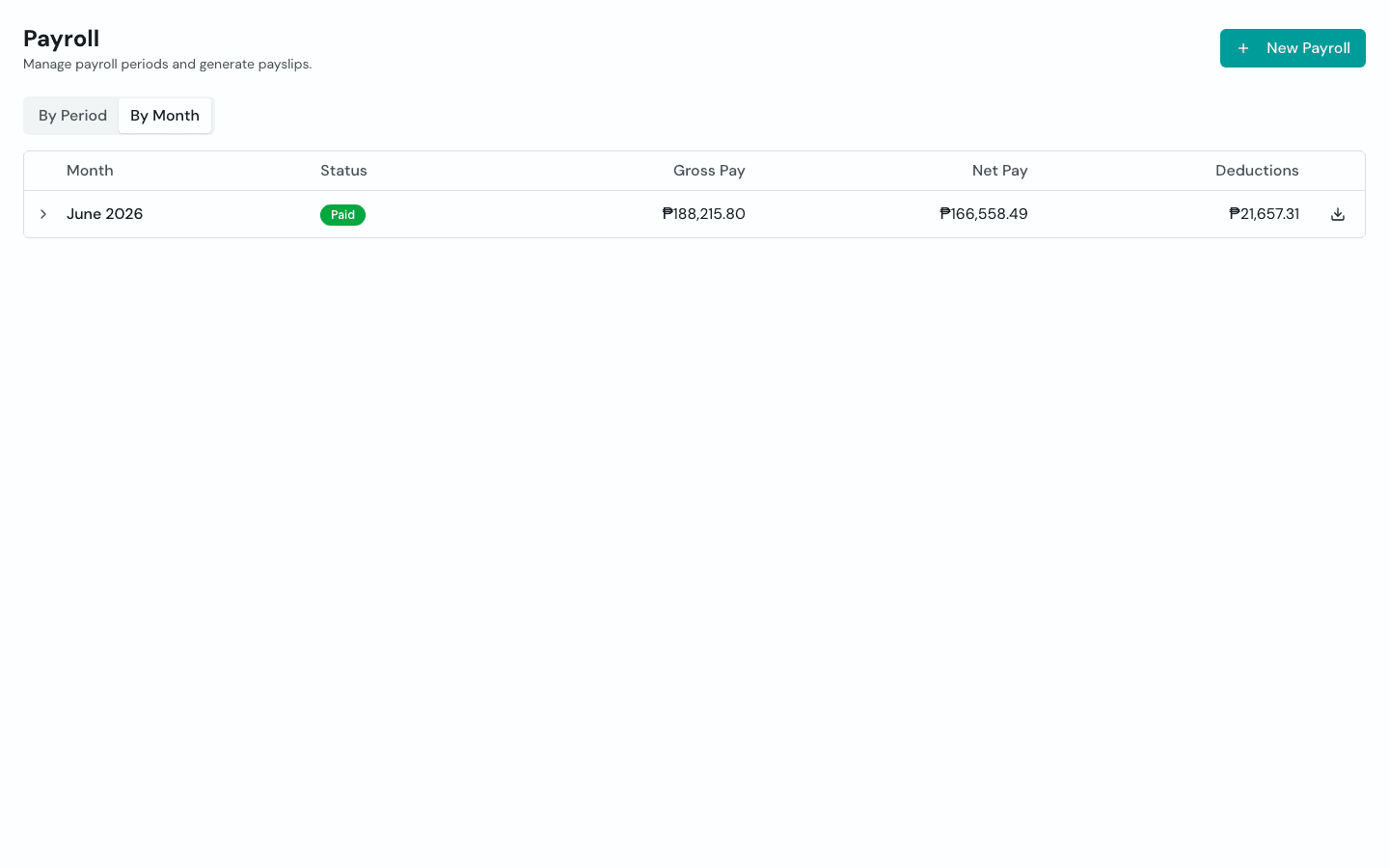
Every payslip records basic pay as its own line, separate from overtime, holiday pay, night differential, and allowances. Late, undertime, and absence deductions each sit in their own field too. So the total basic salary earned for the year is already split out for you, cutoff by cutoff, instead of buried inside gross pay.
Export your payroll reports for the year, add the basic pay column per team member, and divide by 12. The exclusions the law asks for are already separated.
If you started using Timekeep partway through 2026, add the basic salary from your earlier records for the months before you switched. The calendar year drives the formula, not the date you moved systems.
Start the total before December
The formula takes a minute. Building the correct total takes longer, and December is the worst month to reconstruct a year of attendance.
Check your records now, while a missing clock-out or an unrecorded absence is still easy to fix.
Try it free for 30 days at timekeep.ph. No credit card required.
Official sources
- DOLE Bureau of Working Conditions: Workers' Statutory Monetary Benefits Handbook, 2024 edition, especially the section on 13th month pay and its exclusions from basic salary
- DOLE Establishment Report System: file the 13th month pay compliance report
- DOLE Bureau of Working Conditions: Labor Code of the Philippines
- DOLE-BWC reminder on the December 24 payment date and the January 15 report deadline
Quick answers
Frequently asked questions
How do you compute 13th month pay in the Philippines?
Add up the total basic salary the employee earned from January 1 to December 31, then divide by 12. Under PD 851, only basic salary counts. Overtime pay, holiday premium, night differential, and allowances are excluded. For an employee earning ₱18,000 a month with no unpaid absences, the 13th month pay is ₱216,000 ÷ 12 = ₱18,000.
How do you compute 13th month pay for an employee hired mid-year?
Use the same formula. Add the basic salary the employee actually earned, then divide by 12 — not by the number of months worked. An employee hired on August 1 at ₱18,000 a month earns ₱90,000 by December 31, so the 13th month pay is ₱90,000 ÷ 12 = ₱7,500. Any employee who worked at least one month during the calendar year is entitled to a prorated amount.
What is the deadline for 13th month pay in the Philippines?
Employers must release 13th month pay on or before December 24 each year. DOLE allows no exception to this date. Employers must also file a compliance report through the DOLE Establishment Report System by January 15 of the following year.
Is 13th month pay taxable in the Philippines?
13th month pay and other benefits are tax exempt up to ₱90,000 in total for the year. Only the amount above ₱90,000 is taxable and must be added to the employee's taxable income for annualization. Most small business employees stay well under the cap.
Do unpaid absences reduce 13th month pay?
Yes. The formula uses the basic salary the employee actually earned, not the contracted salary. Days lost to absence without pay lower the total, so they lower the 13th month pay. Paid leave does not reduce it, because the employee still earns basic salary on those days.
Does a resigned employee still get 13th month pay?
Yes. An employee who resigns or is separated before December 24 still earns a prorated 13th month pay for the basic salary they received during that calendar year. Pay it as part of their final pay, which DOLE Labor Advisory 06-20 requires you to release within 30 days from the date of separation.
Who is not entitled to 13th month pay?
PD 851 covers rank-and-file employees only. Managerial employees — those who can hire, fire, or effectively recommend such action — are not covered. Employees paid purely on commission, on a boundary basis, or on a task basis are also excluded. Many employers still pay managers a 13th month as company policy.