

Payroll math
How to Compute Overtime Pay in the Philippines 2026
Mar 17, 2026 · 4 min read
It's 11 PM and you're staring at a payslip draft. One of your baristas stayed three extra hours on Rizal Day, which also happened to be her rest day. You know she's owed more than regular overtime, but how much more? The rates stack, and you're not sure you're stacking them right.
Overtime computation in the Philippines is not a flat rate. The amount changes depending on when the extra hours happen, and getting it wrong means either overpaying (which hurts your cash flow) or underpaying (which violates the Labor Code). Here's how it actually works.
The base rule
Under Article 87 of the Labor Code, any work beyond eight hours in a day is considered overtime. The employee earns their regular hourly rate plus 25%.
Regular OT rate = hourly rate x 1.25
To get the hourly rate, divide the daily rate by 8.
Say a team member earns ₱500/day. Their hourly rate is ₱62.50. One hour of regular overtime pays ₱62.50 x 1.25 = ₱78.13.
That's the simplest scenario. It gets more interesting when rest days and holidays are involved.
How rates stack on rest days and holidays
The Labor Code assigns premium rates for rest days, special non-working holidays, and regular holidays. When overtime happens on those days, the premium applies first, and then the 30% overtime surcharge is added on top.
This is where most payroll errors happen. You don't pick the higher rate. You multiply them together.
Rest day overtime
The rest day premium is 130%. Overtime adds another 30% on top of that.
Rest day OT = hourly rate x 1.30 x 1.30 = hourly rate x 1.69
For the ₱500/day team member: ₱62.50 x 1.69 = ₱105.63 per overtime hour.
Special non-working holiday overtime
Special holidays (like Ninoy Aquino Day or Black Saturday) also carry a 130% base, with the same 30% overtime premium on top.
Special holiday OT = hourly rate x 1.30 x 1.30 = hourly rate x 1.69
The multiplier matches rest day OT, but the legal basis is different. One is triggered by the rest day, the other by the holiday type.
Regular holiday overtime
Regular holidays (Christmas Day, Independence Day, Rizal Day) carry the highest base rate at 200%. Overtime adds 30%.
Regular holiday OT = hourly rate x 2.00 x 1.30 = hourly rate x 2.60
For the ₱500/day team member: ₱62.50 x 2.60 = ₱162.50 per overtime hour.
Rest day + special holiday overtime
When a special holiday falls on a rest day, the base rate is 150%. Overtime adds 30%.
Rest day + special holiday OT = hourly rate x 1.50 x 1.30 = hourly rate x 1.95
For the ₱500/day team member: ₱62.50 x 1.95 = ₱121.88 per overtime hour.
Rest day + regular holiday overtime
This is the highest overtime rate in the Labor Code. A regular holiday on a rest day pays 260% for the first eight hours, and overtime adds 30% on top.
Rest day + regular holiday OT = hourly rate x 2.60 x 1.30 = hourly rate x 3.38
For the ₱500/day team member: ₱62.50 x 3.38 = ₱211.25 per overtime hour.
Quick reference table
| Scenario | OT Multiplier |
|---|---|
| Regular workday | 1.25x |
| Rest day | 1.69x |
| Special non-working holiday | 1.69x |
| Regular holiday | 2.60x |
| Rest day + special holiday | 1.95x |
| Rest day + regular holiday | 3.38x |
Full example
Pedro earns ₱500/day. He works a regular shift on Independence Day (a regular holiday), then stays 3 extra hours.
Regular pay for the day: ₱500 x 2.00 = ₱1,000 Overtime rate: ₱62.50 x 2.60 = ₱162.50/hour Overtime pay: ₱162.50 x 3 = ₱487.50 Total for the day: ₱1,000 + ₱487.50 = ₱1,487.50
How Timekeep handles overtime
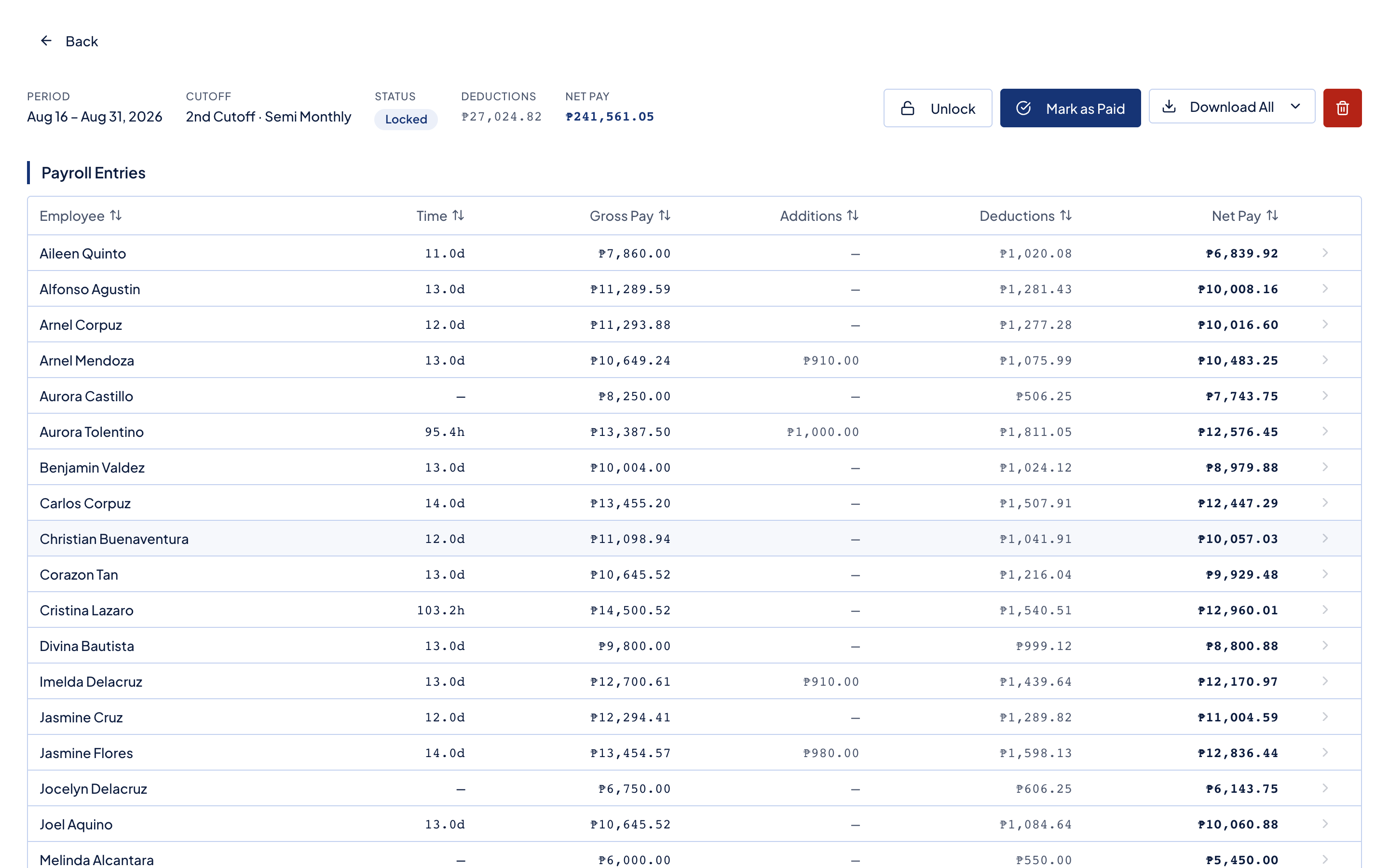
Timekeep computes all overtime rates automatically based on actual clock-in and clock-out times, the team member's assigned schedule, and the holiday calendar. It identifies the type of day, applies the correct stacking multiplier, and shows the full breakdown in payroll. You review the numbers and approve.
No more midnight math
That barista who stayed late on Rizal Day? With the right system, her overtime is computed before you finish your morning coffee. No stacking errors, no second-guessing multipliers.
Try it free for 30 days at timekeep.ph. No credit card required.
Quick answers
Frequently asked questions
What is the overtime pay rate in the Philippines?
Under Article 87 of the Labor Code, overtime pay on a regular workday is the employee's hourly rate plus 25% (1.25x multiplier). The rate increases on rest days (1.69x), special non-working holidays (1.69x), regular holidays (2.60x), and combinations like rest day plus regular holiday (3.38x).
How do you compute overtime pay on a regular holiday in the Philippines?
Multiply the employee's hourly rate by 2.60. The regular holiday base rate is 200%, and overtime adds 30% on top: hourly rate × 2.00 × 1.30 = 2.60x. For example, an employee earning ₱500/day (₱62.50/hour) earns ₱162.50 per overtime hour on a regular holiday.
How do overtime rates stack on rest days and holidays?
You don't pick the higher rate — you multiply them together. First apply the day-type premium (rest day, special holiday, or regular holiday), then add the 30% overtime surcharge on top. For a rest day that is also a regular holiday, the overtime rate is hourly rate × 2.60 × 1.30 = 3.38x.
What is the overtime pay rate on a rest day in the Philippines?
Rest day overtime pay is the hourly rate multiplied by 1.69. The rest day premium is 130% of the hourly rate, and overtime adds another 30% on top: hourly rate × 1.30 × 1.30 = 1.69x. For an employee earning ₱500/day, that's ₱105.63 per overtime hour.
How do you compute the hourly rate for overtime in the Philippines?
Divide the employee's daily rate by 8 (the standard number of working hours per day). For example, a daily rate of ₱500 gives an hourly rate of ₱62.50. All overtime multipliers are applied to this hourly rate.