
Payroll Software in the Philippines: What Cafe and Shop Owners Actually Need
What payroll software in the Philippines must do for cafes and shops: SSS, PhilHealth, Pag-IBIG, BIR, attendance into payslips, and a cutoff you can run without an HR team.
Aug 17, 2026 / 7 min read
Payroll software in the Philippines is a system that turns clock-ins into payslips and already knows SSS, PhilHealth, Pag-IBIG, and BIR. If you run a cafe, bakery, clinic, or shop, that is the product you are looking for. You are not looking for an HR suite, a sales call, or a prettier spreadsheet.
This guide is for the owner who still closes payroll after the floor is quiet. It covers why a spreadsheet cutoff breaks, what the software must do under Philippine rules, and how to choose without buying a tool built for a company with an HR department.
Why a spreadsheet cutoff breaks
A cafe cutoff is not one column of monthly salaries. You often have daily-paid baristas, a monthly-paid supervisor, a late clock-in, approved overtime, a rest-day open, and a holiday in the same 01–15 or 16–31 window. The attendance log lives in another tab, or in a group chat, or on a USB stick from a fingerprint machine.
Then the government layer starts. You look up the SSS table, the PhilHealth rate, the Pag-IBIG amount, and the BIR withholding sequence. You paste a rate you found last month. You hope the formula still points at the right cell.
That process fails in quiet ways:
- A late arrival is in the log, but the sheet still pays a full day.
- Overtime is in chat, not in the file.
- A daily-paid person and a monthly-paid person use the same divisor.
- Last year's SSS bracket is still in the formula.
- Staff get a screenshot instead of a payslip they can read.
None of those need a dramatic story. One wrong cell is enough. The next cutoff copies the same file, so the error repeats.
If you want the repeatable checks, use the payroll checklist for every cutoff. If you are still mixing daily and monthly staff in one column, read daily rate vs monthly salary first. The software cannot fix a pay basis you have not settled.
What payroll software in the Philippines must do
Skip the module list. For a shop, the software has a short job: take the hours that were actually worked, apply Philippine pay rules, deduct the right government amounts, and show each person a payslip you can defend.
Current SSS, PhilHealth, Pag-IBIG, and BIR tables
This is the non-negotiable. The product must compute:
- SSS employee share and employer share from the current contribution table
- PhilHealth premiums with the current rate, floor, and ceiling
- Pag-IBIG employee and employer amounts
- BIR withholding tax on compensation, after the contributions the law takes first
You should not maintain those tables yourself. "Configurable" sounds useful until you are the person who updates the sheet when an agency changes a rate. If the answer is "paste the new table," you still own the spreadsheet.
The employee share comes out of net pay. The employer share is a labor cost. The software must keep those two apart. A share on the wrong side changes real money.
Attendance that becomes the payslip
Clock-in, clock-out, break, late, undertime, overtime, night work, rest-day work, and holiday work should enter payroll from the same records. You review the draft. You do not retype hours from a USB export.
That is what a timekeeping system in the Philippines is for. It is shop software, not the Philippine Standard Time law. If the time clock and the payroll file are separate, you still do the painful part by hand.
Daily, monthly, and hourly pay without a second process
Philippine shops mix pay bases. A daily-paid closer and a monthly-paid shift lead are not the same computation. Holiday treatment, absence treatment, and the daily equivalent all change with the basis.
The software should store the basis on the employee and use it. It should not force every role into one divisor because the template has one column.
A cutoff one owner can finish
You do not have an HR team. The product must let the owner, manager, or bookkeeper:
- close attendance
- generate a draft
- challenge odd net pay
- lock the run
- issue payslips
- export totals for the accountant
If setup takes a week of "configuration workshops," the product is built for someone else.
Payslips staff can open themselves
DOLE and the agencies expect itemised pay. Staff also ask the same three questions every payday: what was deducted, why net pay moved, and where the file is. A portal with a PIN answers those without a screenshot in the group chat.
A short example, not a real shop
These figures are an example. They are not a customer result.
Say the 01–15 cutoff has two people.
- A daily-paid barista at ₱610 a day works 11 scheduled days, is late on one day, and works 2 hours of approved overtime on a Saturday.
- A monthly-paid supervisor at ₱18,000 a month has a fixed semi-monthly basic of ₱9,000, plus one rest-day open.
In a spreadsheet you compute each premium, then look up four government tables, then hope the tax sequence is right. In payroll software the attendance rows should already carry the late minutes, the approved overtime, and the rest-day flag. The draft should show basic pay, premiums, employee shares, employer shares, and net pay as separate lines.
You still approve the run. The software does not decide a disputed absence. It stops you from rebuilding the arithmetic.
How to choose payroll software
Ask the vendor, or the website, these questions. If the answer needs a demo booking, treat that as an answer.
- Are SSS, PhilHealth, Pag-IBIG, and BIR tables built in and kept current?
- Does attendance feed payroll, or do you export a CSV?
- Can you set daily, monthly, and hourly staff in the same business?
- Do overtime, night differential, rest days, and holidays use Philippine rates?
- Can staff open their own payslips?
- Is the price on the website?
- Can you start a trial without a credit card?
If any answer is "we integrate with your existing time clock," you still own the handoff. If pricing is "contact sales," the product is rarely priced for a 10-person floor.
You can ignore most of the rest. HR analytics, salary benchmarking, and a chatbot do not close a cutoff. Fifteen modules mean fifteen places for a setting to hide.
When a spreadsheet is still enough
Keep the sheet if you have a few people on fixed monthly pay, no overtime, and no holiday mix. A tool does not make that cutoff better. It only adds a login.
The break point is variation. Daily and monthly staff in the same run, rest-day opens, approved overtime, a mid-cutoff hire, or a table you keep Googling. That is when the file starts copying last period's mistakes.
What Timekeep is for
Timekeep is payroll software for Philippine small businesses. It is built for cafes and shops that need attendance, schedules, and government-compliant payslips in one place.
It computes SSS, PhilHealth, Pag-IBIG, and BIR from built-in tables. It pulls hours from the same attendance records you already review. It does not ask you to buy a fingerprint machine.
Pricing is public. Timekeep is ₱999/month for up to 10 employees, then ₱49 per additional employee. There is a 30-day free trial. No credit card is required.
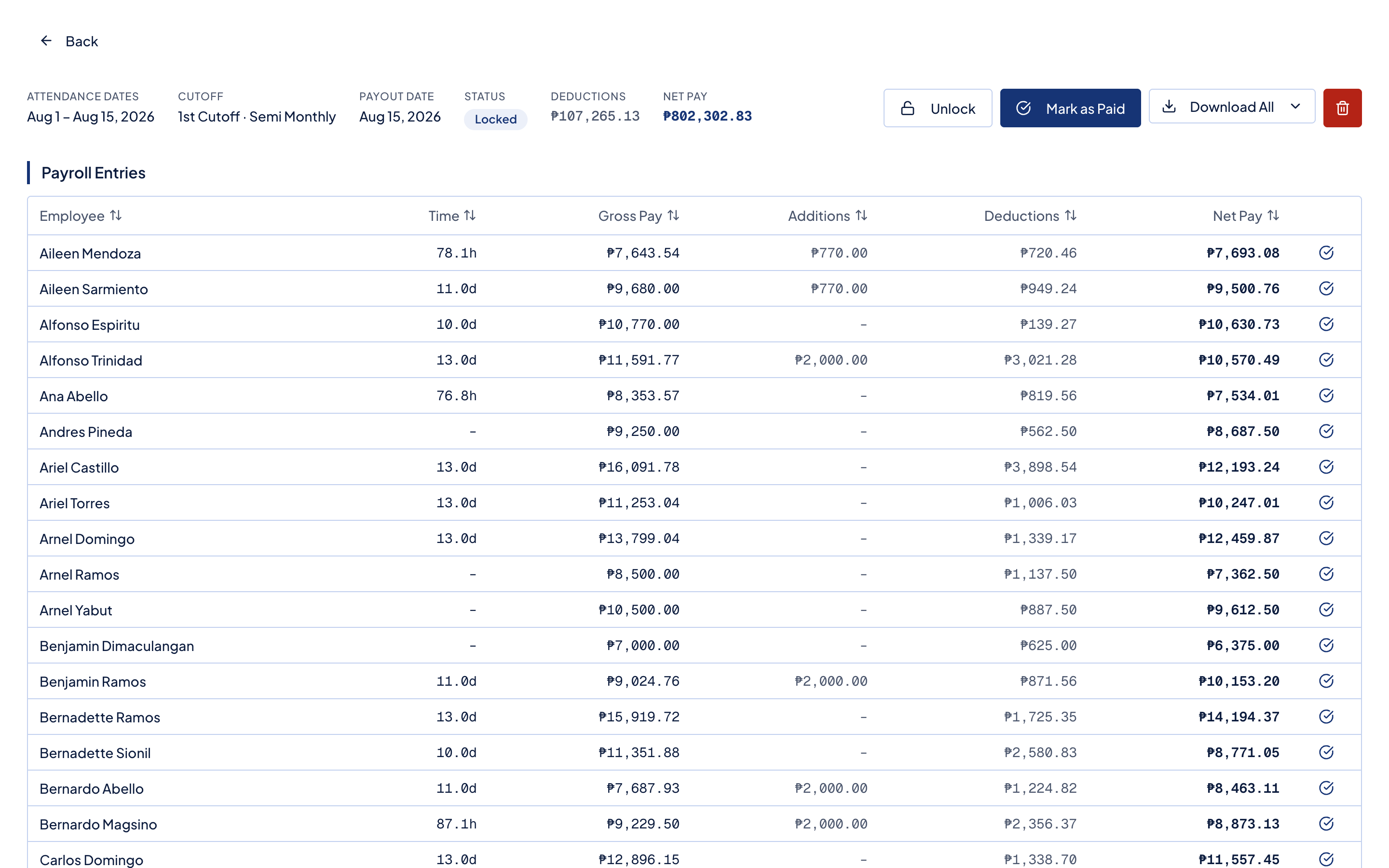
The goal is a boring cutoff. You close attendance, generate the draft, check the odd rows, and pay. For the full review order, keep the cutoff checklist next to the run.
Try Timekeep free at timekeep.ph/signup.
Official sources
- DOLE Bureau of Working Conditions: Workers' Statutory Monetary Benefits Handbook, 2024 edition
- SSS employer guide
- PhilHealth employer guide
- BIR withholding tax
This article gives general guidance, not legal, tax, or accounting advice. Check current DOLE, BIR, SSS, PhilHealth, and Pag-IBIG rules for your case.
Quick answers
Frequently asked questions
- What is payroll software in the Philippines?
- It is software that turns attendance into payslips and already knows SSS, PhilHealth, Pag-IBIG, and BIR withholding. For a cafe or shop, that means the owner can close a cutoff without an HR team and without rebuilding the same spreadsheet.
- What must Philippine payroll software compute?
- It must apply current SSS, PhilHealth, and Pag-IBIG tables, compute BIR withholding on compensation, and use real hours for late, overtime, undertime, night differential, rest days, and holidays. You should not paste government rates into a formula each cutoff.
- Should payroll software include timekeeping?
- Yes for a small shop. If the time clock and the payroll file live in different tools, you still retype hours before payday. A timekeeping system should feed the same records into the payslip.
- How much does Timekeep cost?
- Timekeep is ₱999/month for up to 10 employees, then ₱49 per additional employee. There is a 30-day free trial and no credit card is required.
Make the next payday the easy one.
Set up in an afternoon, run your first cutoff, and see every peso explained on the payslip.
30 days free, no credit card. Then ₱999 a month for up to 10 employees.