
PhilHealth Contribution Table 2026 for Employers
PhilHealth 2026 premium explained: 5% of basic salary, ₱10,000 floor, ₱100,000 ceiling, 50/50 split, worked examples and semi-monthly deductions.
Oct 13, 2026 / 7 min read
Your new staff member asks why ₱375 was deducted for PhilHealth on her first payslip. Your bookkeeper says it should be ₱250. Somebody else in the group chat says the rate went up again this year. Who is right?
PhilHealth is actually the easiest of the government contributions to compute once you know three numbers: 5%, ₱10,000 and ₱100,000. This guide explains what they mean, shows worked examples, and covers how to split the deduction across two cutoffs.
If you just want the answer for one employee, use the free PhilHealth contribution calculator.
The 2026 PhilHealth rate in one line
The monthly premium is 5% of the employee's monthly basic salary, shared 50/50 between the employee and the employer.
Two limits apply:
- Floor: ₱10,000. If the basic salary is below ₱10,000, compute on ₱10,000. The lowest premium is ₱500 a month.
- Ceiling: ₱100,000. If the basic salary is above ₱100,000, compute on ₱100,000. The highest premium is ₱5,000 a month.
So every employee pays between ₱250 and ₱2,500 a month, and the employer pays the same amount on top.
Why the 2024 to 2025 rate still applies in 2026
The rates come from PhilHealth Circular No. 2020-0005, which set a schedule under the Universal Health Care Act. The last row of that schedule is labeled "2024 to 2025": 5%, ₱10,000 floor, ₱100,000 ceiling. PhilHealth Advisory No. 2025-0002 confirmed the same figures for 2025.
There is no new premium schedule for 2026. PhilHealth has not issued a circular or advisory that changes the rate, and it publicly said there is no increase for 2026. So employers keep using the 2024 to 2025 row. If you were searching for the "PhilHealth contribution 2024" table, it is the same one.
The rate rose in steps under the Universal Health Care Act and reached 5% in 2024. A scheduled 2023 increase to 4.5% was suspended, so 4% stayed in force that year.
How to compute PhilHealth contribution, step by step
- Get the monthly basic salary. Only the fixed basic rate counts (more on this below).
- Apply the floor and ceiling. Below ₱10,000, use ₱10,000. Above ₱100,000, use ₱100,000.
- Multiply by 5%. This is the total monthly premium.
- Split it in half. The employee share is deducted from pay. The employer share is an extra business cost.
The employee share is 2.5% of the base and the employer share is 2.5% of the base.
Worked examples at different salaries
| Monthly basic salary | Base used | Total premium (5%) | Employee share | Employer share |
|---|---|---|---|---|
| ₱8,000 | ₱10,000 | ₱500.00 | ₱250.00 | ₱250.00 |
| ₱10,000 | ₱10,000 | ₱500.00 | ₱250.00 | ₱250.00 |
| ₱15,000 | ₱15,000 | ₱750.00 | ₱375.00 | ₱375.00 |
| ₱25,000 | ₱25,000 | ₱1,250.00 | ₱625.00 | ₱625.00 |
| ₱50,000 | ₱50,000 | ₱2,500.00 | ₱1,250.00 | ₱1,250.00 |
| ₱100,000 | ₱100,000 | ₱5,000.00 | ₱2,500.00 | ₱2,500.00 |
| ₱150,000 | ₱100,000 | ₱5,000.00 | ₱2,500.00 | ₱2,500.00 |
A few things to notice:
- At the minimum, a staff member earning ₱8,000 pays the same as one earning ₱10,000, because the floor applies.
- At ₱15,000, the math is simple: ₱15,000 × 5% = ₱750, so ₱375 each. That is the ₱375 from our opening story.
- At ₱25,000, ₱25,000 × 5% = ₱1,250, so ₱625 each.
- At ₱100,000 and above, the premium stops growing. A manager earning ₱150,000 pays the same ₱2,500 as one earning ₱100,000.
You can check any salary in seconds with the PhilHealth calculator.
What counts as monthly basic salary
This is where most mistakes happen. PhilHealth uses monthly basic salary (MBS), which the circular defines as the employee's fixed basic rate. It does not include:
- Sales commission
- Overtime pay
- Allowances
- 13th month pay
- Bonuses or other gratuity payments
Also, deductions for absences, tardiness, undertime and leave without pay do not lower the base. If a staff member on a ₱20,000 monthly rate was absent for two days, PhilHealth is still computed on ₱20,000, not on what they actually earned that month.
This is different from SSS, which includes regular allowances in the base. See our SSS contribution table guide for how that one works.
Daily-paid staff. For employees paid by the day, the circular says to use the estimated equivalent monthly rate from the DOLE handbook. That is the daily rate times the number of paid days in a year, divided by 12. For example, a ₱700 daily rate on a 261-day year is ₱700 × 261 ÷ 12 = ₱15,225 a month. Our guide on daily rate vs monthly salary explains the different annual factors.
Splitting PhilHealth across semi-monthly cutoffs
PhilHealth sets a monthly premium. The circular says nothing about how to split it across paydays, so you can choose what works for your business:
- Split it evenly. A ₱15,000 earner has ₱187.50 deducted on each of the two cutoffs.
- Deduct it all in one cutoff. The full ₱375 comes out of either the first or the second payday.
Either way, the total for the month must equal the monthly employee share. Splitting keeps take-home pay more even. Deducting once is simpler to check. Pick one method and use it every month. If you are still setting up your pay schedule, see how to set up payroll cutoffs.
Remittance basics
The circular sets these rules for employers:
- Remit the full premium, both the employee share and the employer share, and submit the remittance report on or before the schedule PhilHealth prescribes.
- Late payment costs more. Missed contributions must be paid with interest, compounded monthly, of at least 3% for private employers.
- Not remitting is an offense under Section 38 of the Universal Health Care Act. Your employee can still use PhilHealth benefits even if you did not pay, so the risk falls on the business.
- Keep remitting during maternity leave. The employer must continue paying premiums for women on maternity leave.
A few special cases are worth knowing:
- Kasambahay: if the monthly salary is below ₱5,000, the household employer pays the whole premium. At ₱5,000 or more, the kasambahay pays a share.
- Employed persons with disability (PWD): the employer pays its half, and the National Government pays the employee half.
Common PhilHealth mistakes
Adding allowances to the base. A staff member on ₱20,000 basic plus a ₱2,000 allowance should pay on ₱20,000 (₱500 each), not ₱22,000.
Lowering the premium for absences. The base is the fixed rate. Absences and tardiness do not reduce it.
Forgetting the floor. Part-time or low-paid staff still pay at least ₱250 each, because the base is never lower than ₱10,000.
Treating the employer share as a deduction. The employer's half is a business cost, not something you take from the employee. Budget for it in your cost of hiring an employee.
Computing tax before PhilHealth. The employee's PhilHealth share is deducted before withholding tax is computed. Our BIR withholding tax guide walks through the order.
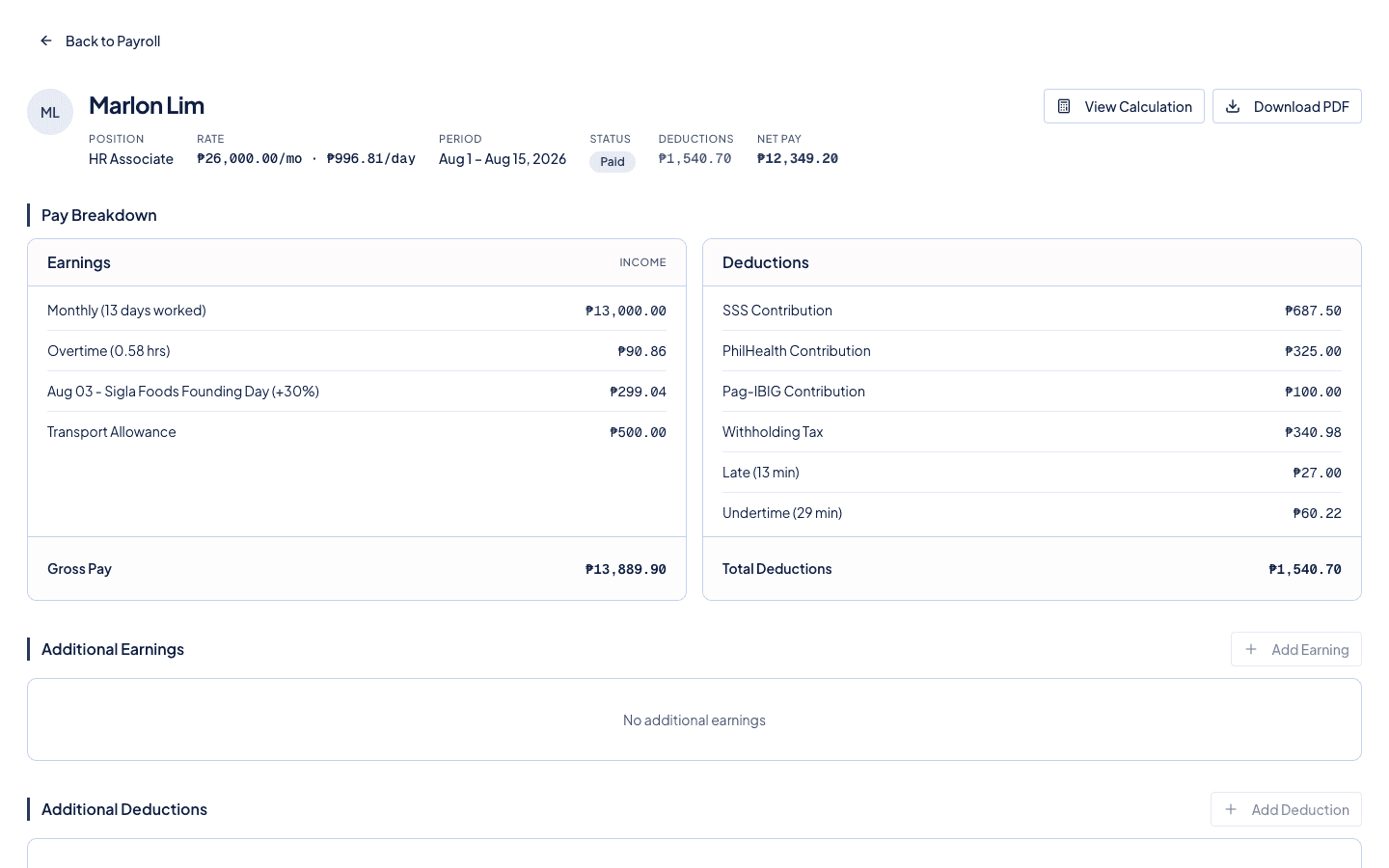
Let the payslip do the math
Once you know the rule, PhilHealth is just 5% of a number between ₱10,000 and ₱100,000, split in two. Doing it by hand for every staff member, every cutoff, is still where errors slip in.
Timekeep is payroll software built for Philippine small businesses. It computes the standard PhilHealth employee and employer shares on every payslip, along with SSS, Pag-IBIG and withholding tax. For special cases such as daily-paid staff with many absences, employed PWDs or a kasambahay, compare the payslip with the rules above before you remit. Timekeep does not yet apply the PWD or kasambahay sharing rules, so work out those shares by hand. You can read how Timekeep computes government deductions, check a single salary with the PhilHealth calculator, or try Timekeep free for 30 days with no credit card.
Quick answers
Frequently asked questions
- What is the PhilHealth contribution rate for 2026?
- The PhilHealth premium for 2026 is 5% of the employee's monthly basic salary, with a ₱10,000 floor and a ₱100,000 ceiling. This is the 2024 to 2025 rate from PhilHealth Circular No. 2020-0005, carried forward because no new schedule has been issued for 2026. The monthly premium runs from ₱500 to ₱5,000.
- How do I compute the PhilHealth contribution of an employee?
- Take the employee's monthly basic salary. If it is below ₱10,000, use ₱10,000. If it is above ₱100,000, use ₱100,000. Multiply by 5% to get the total monthly premium, then split it equally: half is deducted from the employee and half is paid by the employer. For a ₱20,000 basic salary, the premium is ₱1,000, or ₱500 each.
- How much was the PhilHealth contribution in 2024?
- In 2024 the PhilHealth premium was 5% of monthly basic salary, with a ₱10,000 floor and a ₱100,000 ceiling, for a monthly premium of ₱500 to ₱5,000 split equally between employee and employer. The same figures applied in 2025 and still apply in 2026.
- Are allowances and overtime included in the PhilHealth base?
- No. PhilHealth uses monthly basic salary, which does not include sales commission, overtime pay, allowances, 13th month pay, bonuses or other gratuity payments. Deductions for absences, tardiness, undertime and leave without pay also do not lower the base, so the premium is computed on the employee's fixed basic rate.
- What is the maximum PhilHealth contribution in 2026?
- The maximum is ₱5,000 a month in total, reached at a monthly basic salary of ₱100,000. The employee pays ₱2,500 and the employer pays ₱2,500. Anyone earning more than ₱100,000 a month pays the same ₱5,000 total.
- What happens if an employer pays PhilHealth late?
- Under PhilHealth Circular No. 2020-0005, missed contributions must be paid with interest, compounded monthly, of at least 3% for private employers. Failure to remit is also an offense under Section 38 of the Universal Health Care Act. The employee can still use PhilHealth benefits even if the employer did not pay.
Make the next payday the easy one.
Set up in an afternoon, run your first cutoff, and see every peso explained on the payslip.
30 days free, no credit card. Then ₱999 a month for up to 10 employees.